Lambok and his elder sister Phiban live in Shillong. One day they came home from school. Their parents were away at work and Lambok complained that he was feeling feverish. Phiban touched his forehead and felt that he might be having a fever. To confirm this, she took out the thermometer kept in the almirah. She washed its tip with soap and water, and measured Lambok's temperature. To her relief, she found that his temperature was normal. She washed the thermometer tip again, dried it and put it back.
We know from experience that some bodies are hotter than others. For example, during summers, the tap water may be hotter than the cold water from a matka (earthen pot) or a refrigerator. We can realise this by merely touching the two samples of water. But can we always rely upon our sense of touch? Let us find out.
Compare whether your observations match with your predictions. Did your right hand feel that the water in container B is cool, while your left hand felt that the same water is warm? We cannot always rely upon our sense of touch to decide correctly whether a body is hot or cold.
- •Take three large containers and label them A, B and C.
- •Pour warm water in container A, tap water in B and ice-cold water in C.
- •We will conduct this activity in two parts — prediction and observation.
- •Firstly, predict what will you feel if you dip your right hand in A and left hand in C and keep them there for 1–2 minutes.
- •Then take out your hands from containers A and C, and place both hands simultaneously in B.
- •Write down your predictions: What will my right hand feel on dipping in B? [___] | What will my left hand feel on dipping in B? [___]
- •Now, conduct the activity and write your observations.
You might be familiar with a thermometer which is used for measuring our body temperature. It is called a clinical thermometer. Such thermometers show temperatures digitally. These are also known as digital clinical thermometers and run on batteries. These measure temperature when the thermometer is placed in contact with a person's body.

- To be used after reading the instruction manual of the thermometer.
- Tip of the thermometer to be washed with soap and water before and after use.
- While washing, care to be taken to keep the digital portion such as the display out of water.
- Do not hold the thermometer by the tip.
The normal temperature of a healthy human body is taken to be 37.0 °C. The temperature of every person may not be 37.0 °C. The body temperature is influenced by several factors, such as age, time of the day and activity level. The temperature of human beings does not normally go below 35 °C or above 42 °C.
- •Wash your hands and the tip of the digital thermometer with soap and water.
- •Reset the thermometer by pressing the reset button.
- •Place the thermometer under the tongue and close your mouth.
- •Wait till the thermometer makes a beeping sound or flashes a light.
- •Take it out from the mouth and read the temperature on the digital display.
- •Record the temperature in Table 7.1.
- •Clean the tip of the thermometer with soap and water, and dry it.
- •Repeat the above steps for measuring the temperatures of your friends.
Table 7.1: Body temperatures of 10 persons
| S. no. | Name | Temperature (°C) |
|---|---|---|
| 1 | ||
| . | ||
| . | ||
| . | ||
| . | ||
| 10 |
The temperature of human beings does not normally go below 35 °C or above 42 °C. For measuring the body temperature of small children or old people, the digital thermometer can also be placed in the armpit. The temperature measured this way is about 0.5 °C to 1 °C lower than the actual body temperature.
There are many types of laboratory thermometers. One type consists of a long, narrow, uniform glass tube which is sealed. At one end of the tube is a bulb which contains a liquid. Outside the bulb, in the tube, a narrow column of liquid can be seen. There is a Celsius scale marked along the tube. The liquid column rises or falls with change in temperature. The mark of the Celsius scale with which the top level of the liquid column coincides is the temperature reading.
For the thermometer in Fig. 7.3a, the range is from –10 °C to 110 °C.
- •Take a laboratory thermometer and observe it carefully.
- •Note down: What is the lowest temperature it can measure? [___]
- •What is the highest temperature it can measure? [___]
- •So, the range of this thermometer is [___]
- Handle with care. If it hits against some hard object, it can break.
- Do not hold it by the bulb.
For the thermometer in Fig. 7.3b: temperature difference between 0 °C and 10 °C is 10 °C, and there are 10 divisions between them. So one small division = 10/10 = 1 °C. The smallest value that this thermometer can read is 1 °C.
- •Take the same laboratory thermometer used in Activity 7.3 and observe it carefully.
- •How much is the temperature difference indicated between the two bigger marks? [___]
- •How many divisions (shown by smaller marks) are there between these two bigger marks? [___]
- •How much temperature does one small division indicate? [___]
- •So, the smallest value that the thermometer can read is [___]
- When the thermometer is immersed in water, its bulb should not touch the bottom or the sides of the beaker.
- The thermometer should be held vertically. It should not be tilted.
- The temperature must be read while the thermometer is immersed in water.
- While reading the thermometer, the eye should be directly in line with the level of the liquid column to be read.
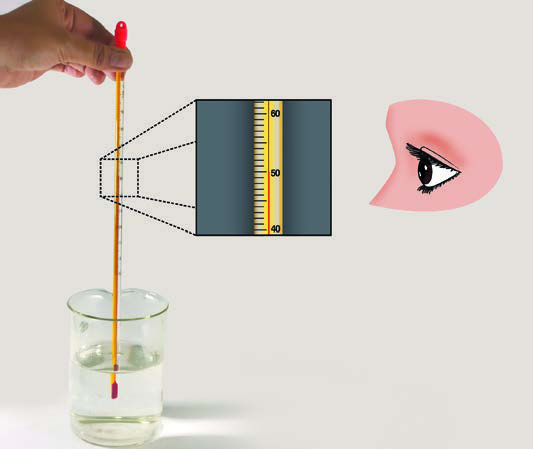
Do you notice that, as soon as you take the thermometer out of the water, the level of liquid column begins to fall? This means that the temperature must be read while the thermometer is immersed in water.
- •Take some warm water in a beaker.
- •Dip the thermometer in water so that the bulb is immersed in water (Fig. 7.4).
- •Observe the rise of liquid column in the thermometer.
- •Wait till the column stops rising and note the temperature.
- •Compare your reading with the readings of your friends.
- •Phiban's Science teacher arranged the experimental setup for measuring temperature of boiling water.
- •The temperature readings of the boiling water taken by Phiban and her classmates are given in Table 7.2.
- •Compare the temperatures of boiling water recorded by different students.
- •Discuss the possible reasons for differences in their readings.
Table 7.2: Temperature of boiling water (recorded in Shillong)
| Name | Temperature of boiling water (in °C) |
|---|---|
| Phiban | 97.8 |
| Shemphang | 98.0 |
| Onestar | 97.9 |
| Kloi | 98.0 |
| Bandarisha | 98.1 |
You might have seen thermometers hung on walls of your school laboratory, doctor's clinic, and hospitals. These give an approximate idea of the room temperature. Have you seen weather reports in newspapers, TV news or internet? These reports also mention the maximum and minimum air temperature of the day.
Because weather depends on several factors, temperatures usually vary every day. Generally, as we approach the summer season, the temperature rises and during the winter season it falls.
- •Read or listen to the weather reports for a place for 10 successive days.
- •Record the maximum and minimum air temperature for each day in Table 7.3.
- •Analyse the data in the Table 7.3.
- •Does the maximum and minimum temperature stay at the same level during these days?
Table 7.3: Maximum and minimum air temperature
| S.no. | Date | Maximum air temperature | Minimum air temperature |
|---|---|---|---|
| 1. | |||
| . | |||
| . | |||
| 10. |
Keywords
- 1The temperature of a body tells us how hot or cold it is.
- 2The three most-used scales of temperature are: (a) the Celsius scale, (b) the Fahrenheit scale, and (c) the Kelvin scale.
- 3The units of temperature in these scales are: (a) degree Celsius (°C), (b) degree Fahrenheit (°F), and (c) kelvin (K).
- 4The SI unit for temperature is kelvin.
- 5A clinical thermometer is used for measuring body temperature.
- 6Normal temperature of a healthy human adult is taken to be 37.0 °C or 98.6 °F.
- 7Laboratory thermometers typically have a temperature range from –10 °C to 110 °C.
- Gather information from the Internet and find out how the body temperature of animals, such as a cat, dog, horse, camel, cow and buffalo, is measured. If there is any veterinary hospital in your vicinity, you may visit to see the body temperature of animals being measured.
- Find out which places in India are usually regarded to be the coldest and hottest. Also, find out the minimum and the maximum temperatures recorded for these places.
- Various planets in our Solar System are at different distances from the Sun. Search the Internet and make a table with the planets, their distances from the Sun (in increasing order) and their temperatures written. Does the average temperature of planets decrease as their distance from the Sun increases?
- Hang a room thermometer in your classroom. Take readings of two thermometers three times during the day (first period, lunch break, last period). Record your readings, compare them and draw conclusions. Repeat this for two weeks.
- More to know: The temperature at the core of the Sun reaches as high as 15 million degrees Celsius. The lowest temperature that can be achieved is close to -273.15 °C (0 kelvin), called absolute zero.