Medu and Mishti read 'thought of the day' on the school noticeboard every day. Today's thought, "annena jātāni jīvanti", makes them curious. Mishti tells Medu that it is a Sanskrit saying which means "food gives life to living beings." (Taittirīya Upaniṣada)
Let us try to understand the significance of this saying.
- •All of us eat food every day. Food is an essential component of our daily life. List the food items you have consumed over the week in Table 3.1.
Table 3.1: Food items consumed over a week
| Day | Food items |
|---|---|
| Monday | |
| Tuesday | |
| Wednesday | |
| Thursday | |
| Friday | |
| Saturday | |
| Sunday |
What observations can you make about your food from the data collected in Table 3.1? Do you eat the same kind of food in every meal or do your choices vary? Compare your list with those prepared by your friends. Find similarities and differences in the food consumed by you and your friends. What did you find? Record your findings in your notebook. You may have noticed that there is a variety in the food eaten by you and your friends.
Do you think that such diversity in food exists in all states of our country?
- •Find out the types of food traditionally consumed and the crops grown in various states of India. You may refer to books in your library, search the internet, and interact with your friends, family and neighbours to collect information.
- •In Table 3.2, add more states and fill the collected data. A few examples are already given.
Table 3.2: Some traditional food items in various states of India
| State | Locally grown crops | Traditional food items eaten | Beverages |
|---|---|---|---|
| Punjab | Maize, wheat, chickpea, pulses | Makki di roti, sarson da saag, chhole bhature, parantha, halwa, kheer | Lassi, chhach (buttermilk), milk, tea |
| Karnataka | Rice, ragi, urad, coconut | Idli, dosa, sambhar, coconut chutney, ragi mudde, palya, rasam, rice | Buttermilk, coffee, tea |
| Manipur | Rice, bamboo, soya bean | Rice, eromba (chutney), utti (yellow peas and green onion curry), singju, kangsoi | Black Tea |
Why do we see diversity in traditional food consumed in various states of our country?
Analyse the data collected by you in Table 3.2. Are there food items that are common across many states? Make a list of those food items. You may find that some food items are common in many states while some are eaten only in a particular state.
What relation do you find between the traditional food items and the locally grown crops? You must have observed that the traditional food of any state is usually based on the crops grown in that state. India is an agricultural country with diverse soil and climate types. Various crops are grown in its different regions depending on the soil types and climatic conditions.
You have learnt that food habits vary across states. Our food choices as well as practices of food preparation may differ from one another. Have our food habits and cooking practices changed over time?
- •Prepare a list of questions for gathering information from elderly people about their food habits and cooking practices. Following are some sample questions:
- •• What kind of food do you still eat and what is new?
- •• What are the changes in cooking practices over time?
- •• What has caused these changes?
- •Conduct interviews with some elderly people based on the questions prepared.
 Chulha (Traditional stove).jpeg)
 Modern gas stove.jpeg)
 Sil-batta (Stone grinder).jpeg)
 Electrical grinder.jpeg)
Medu and Mishti visit the 'Traditional Food Festival' organised in their school. The theme of the festival is 'Eat Healthy, Live Healthy'. The festival features various stalls displaying different kinds of traditional dishes. Dr Poshita, a nutritional expert, explains to students that "Health is the Ultimate Wealth".
Have you ever missed a meal? How do you feel when you miss a meal? We feel tired and less energetic when we do not eat for some time. Why do you think a marathon runner drinks glucose water during and after a race?
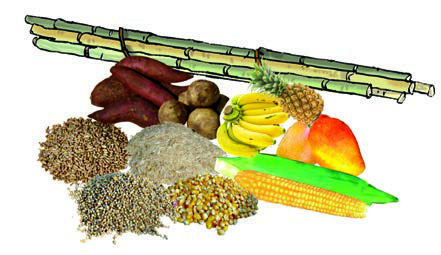
Do you know that common sugar is also a type of carbohydrate? Why do you think we prefer to have laddoos as a part of our traditional diet in winters?
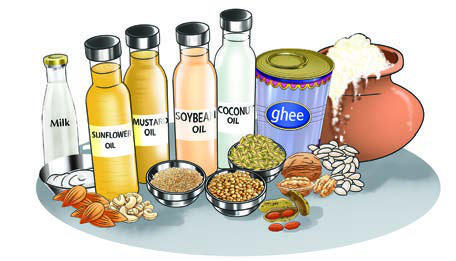
Why do you think we are advised to include servings of fruits, vegetables and other plant-based foods in our daily diet? Let us understand the importance of some other food components by reading the following two cases—
- •Study the chart given in Fig. 3.5 to explore the functions and sources of various food components. Find out more sources of vitamins and minerals. Also, understand the symptoms of the diseases caused by the lack of these food components.
- •Visit your neighbourhood, interact with people and find out if any individual shows the symptoms listed on the chart (an investigatory project of this kind can be taken by the students under the guidance of a teacher).
- •Correlate these symptoms with their diet and identify the deficiency disease(s) or disorder(s).
- •Suggest the possible cause(s) for the symptoms observed and changes required in the diet for improvement.
- •Suggest them to visit a doctor for further advice.
Fig. 3.5: Chart of vitamins and minerals, their functions, sources, related deficiency diseases and symptoms
| Food component (Vitamin / Mineral) | Functions | Some sources | Deficiency disease / disorder | Symptoms |
|---|---|---|---|---|
| Vitamin A | Keeps eyes and skin healthy | Papaya, carrot, mango, milk | Loss of vision | Poor vision, loss of vision in darkness (night blindness), sometimes complete loss of vision |
| Vitamin B₁ | Keeps heart healthy and supports body to perform various functions | Legumes, nuts, whole grains, seeds, milk products | Beriberi | Swelling, tingling or burning sensation in feet and hands, trouble in breathing |
| Vitamin C | Helps body to fight diseases | Amla, guava, green chilli, orange, lemon | Scurvy | Bleeding gums, slow healing of wounds |
| Vitamin D | Helps body absorb calcium for bone and teeth health | Exposure to sunlight, milk, butter, fish, eggs | Rickets | Soft and bent bones |
| Calcium | Keeps bones and teeth healthy | Milk/soya milk, curd, cheese, paneer | Bone and tooth decay | Weak bones, tooth decay |
| Iodine | Helps to perform physical and mental activities | Seaweed, water chestnut (singhada), iodised salt | Goitre | Swelling at the front of the neck |
| Iron | Important component of blood | Green leafy vegetables, beetroot, pomegranate | Anaemia | Weakness, shortness of breath |
From Fig. 3.5, you have learnt that vitamins (A, B₁, C and D) and minerals (calcium, iodine, and iron) are two groups of food components that protect our body from various diseases. But, how can we overcome vitamin and mineral deficiency diseases or disorders?
What differences do you observe in raw and cooked vegetables? Have you ever noticed that vegetables sometimes lose their bright colour, or become softer and less crisp when cooked? Some nutrients like vitamin C and others are lost during cooking due to high heat. Would it not be wise to include fruits and uncooked vegetables into our diet? Washing cut or peeled vegetables and fruits may also result in the loss of some vitamins. However, it is highly recommended that all fruits and vegetables be thoroughly washed before consumption.
Eating food that is locally grown and plant based, to the extent possible, is not only healthy for the body but is also good for our environment and our planet.
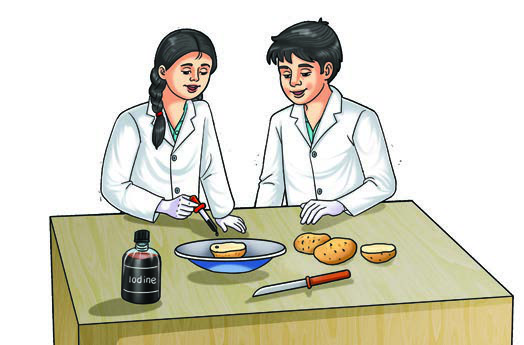
Let us find out which nutrients are present in various food items. Some nutrients like starch (a type of carbohydrate), fat and protein can be detected using fairly simple tests, while others can be detected only in a well-equipped laboratory. Let us explore how we can detect the presence of starch, fat and protein in some food items.
- •Take a small quantity of the food items such as a slice of potato, cucumber, bread, some boiled rice, boiled gram, crushed peanuts, oil, butter and crushed coconut. You can take other food items too for testing.
- •Place a small piece of each item on a separate dish.
- •With the help of a dropper, put 2–3 drops of diluted iodine solution on each food item.
- •Observe if there are any changes in the colour of the food items. Have they turned blue-black? Record your observations in Table 3.3.
- •A blue-black colour indicates the presence of starch.
- •Take a small part of the food items that you tested for the presence of starch in Activity 3.5.
- •Place each food item on a separate piece of paper.
- •Wrap the paper around the food and press it. Be careful not to tear the paper.
- •If a food item contains a little water, allow the paper to dry.
- •Does the paper develop an oily patch? If oil or butter is present in the food item, it leaves an oily patch on the paper. Hold the paper against light. Can you see the light faintly shining through this patch?
- •An oily patch on the paper shows that the food item contains fat. Record your observations in Table 3.3.
This activity may be demonstrated by the teacher.
- •Take the food items tested in previous activities.
- •Make a paste or powder of the food item using pestle and mortar.
- •Put about half teaspoon of each food item in a separate clean test tube.
- •Add 2–3 teaspoons of water to each test tube and shake them well.
- •Add two drops of copper sulphate solution to each test tube using a dropper.
- •Now, take another dropper and add 10 drops of caustic soda solution to each tube.
- •Shake well and leave the test tubes undisturbed for a few minutes.
- •Did the content of some test tubes turn violet? This violet colour indicates the presence of proteins in the food item. Write your observations in Table 3.3.
- These chemicals are harmful and need to be handled with care. Do not touch any of these chemicals unless asked to do so.
- If any chemical gets spilled on your body, immediately wash the affected area with water.
- Do not put any of these chemicals into your mouth, or try to smell them.
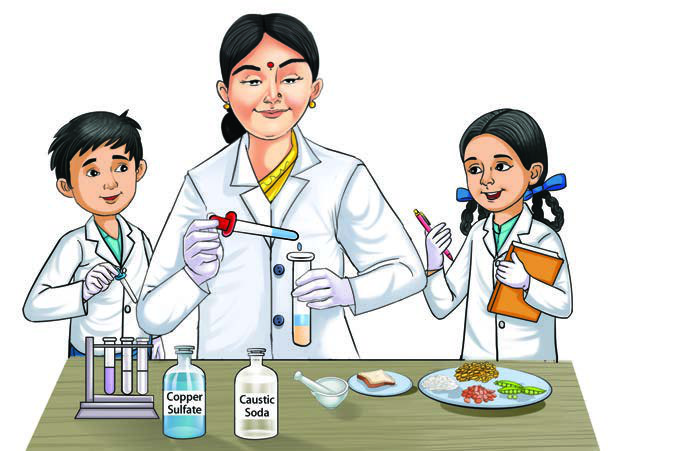
Table 3.3: Exploring nutrients present in various food items
| Name of the food item | Colour before iodine test | Colour after iodine test | Oily patch prediction (Yes/No) | Oily patch observation (Yes/No) | Colour before protein test | Colour after protein test | Starch present (Yes/No) | Fat present (Yes/No) | Protein present (Yes/No) |
|---|---|---|---|---|---|---|---|---|---|
| Potato | |||||||||
| Cucumber | |||||||||
| Boiled rice | |||||||||
| Boiled gram | |||||||||
| Peanuts | |||||||||
| Bread / Chapati | |||||||||
| Butter | |||||||||
| Coconut | |||||||||
What conclusions can you draw from Table 3.3? Which food items show the presence of more than one nutrient? Peanuts show the presence of both proteins and fats. This indicates that any food which we eat may contain multiple nutrients. Try to find out other foods that are good sources of starch, fats, and proteins.
Are nutritional requirements the same for everyone? Do you and your grandparents need the same type or the same amount of nutrients? Requirements of the type and amount of nutrients in a diet may vary according to age, gender, physical activity, health status, lifestyle, and so on.
- •You have listed food consumed by you during the week in Activity 3.1. Check whether your food contains all the nutrients and other essential components necessary for growth and development. If not, check which nutrients or other food components need to be added.
- •Read the nutritional information given below for a packet of potato wafers and a packet of roasted chana.
Nutritional Information Comparison (per 100 g)
| Nutrient | Potato wafers | Roasted chana |
|---|---|---|
| Energy | 536.0 kcal | 355 kcal |
| Fats | 35.0 g | 6.26 g |
| Carbohydrates | 53.0 g | 58.58 g |
| Proteins | 7.0 g | 18.64 g |
| Dietary Fibre | 4.8 g | 16.8 g |
Based on the nutritional information on the food packets given above, which food would you choose? Why?
Some foods have high calories due to high sugar and fat content. Moreover, they contain very low amounts of proteins, minerals, vitamins, and dietary fibres. These foods are called junk foods. These foods include potato wafers, candy bars and carbonated drinks. Consuming these foods frequently is not good as these are not healthy for our body. They make a person obese. Such a person may suffer from several health problems. You should always remember Dr Poshita's statement that "Health is the Ultimate Wealth." We should take care of our body to stay healthy. Eating a balanced diet and avoiding junk food contribute towards a healthy body. Good health is essential for leading a happy life.
You may have heard of jowar, bajra, ragi, and sanwa. These are native crops of India. These can be easily cultivated in different climatic conditions. These highly nutritious grains are also called millets. Have you ever had food items made from these millets?
.jpeg)
Millets are small-sized grains and have been an integral part of the Indian diet for centuries. They have regained popularity due to their numerous health benefits. They are good sources of vitamins, minerals like iron and calcium, and dietary fibres as well. That is the reason they are also called nutri-cereals. They contribute significantly to a balanced diet required for the normal functioning of our body.
How does food reach from a farm to our plate? What are the steps involved in this process? Who are the people involved in this process? Do you know how much time and effort is required to get the wheat flour once seed grains germinate in the farm? Let us look at Fig. 3.10 to understand the entire process of making the chapati that we eat.
Many people waste food, leaving it unconsumed on their plates. One must remember the time and effort put by our farmers and other community members in getting the food from the farm to our plate. We must take only as much food as we can consume. It would reduce food wastage.
Eat healthy, share, and respect food. Support local producers!
Keywords
- 1People across India eat diverse types of food, containing various food components.
- 2Choice of food may vary according to the cultivation of food crops in a region, taste preferences, culture and traditions, and so on.
- 3Culinary practices have changed over time. There is a significant difference between traditional and modern methods of cooking food.
- 4Food provides us energy, support growth, repairs our bodies and protects us from diseases.
- 5The major nutrients in our food are carbohydrates, fats, proteins, vitamins, and minerals. In addition, food also contains dietary fibres and water.
- 6Carbohydrates and fats are primary energy sources, while proteins are body-building nutrients.
- 7Vitamins and minerals strengthen our body, protect us from infections, and keep us healthy.
- 8A balanced diet provides all the essential nutrients in the right quantities, along with adequate roughage and water.
- 9Deficiency of one or more nutrients in our diet for a long time can lead to deficiency diseases and disorders.
- 10Junk foods are unhealthy as they contain high levels of sugar and fats but little protein, minerals, vitamins, and dietary fibres.
- 11Millets are known as nutri-cereals as they provide most of the nutrients required for the normal functioning of our bodies. They can be easily cultivated in different climatic conditions.
- 12Eating food that is locally grown and plant based, to the extent possible, is not only healthy for our bodies but is also good for our environment and our planet.
- 13The distance travelled by a food item, from the place of its production to the consumer, is called food miles. We must aim to minimise food miles.
- 14We should never waste food and only take as much as we can consume.
- Help your mother in unpacking the packets of various food items after shopping for grocery next time. Read the nutritional information of at least three fortified food items and analyse those.
- The Apatani tribe of Arunachal Pradesh produces a salt called tapyo to fulfil their dietary requirements. Collect more information from the internet about their salt making process and the need to make their own salt. Collect pictures and paste them on a chart paper. Also, write a paragraph about the process of making this salt and its usefulness.
- Vegetables or fruits that grow naturally in the forest or nearby fields without being cultivated by farmers are considered wild varieties. Traditionally, many tribal groups in India depend on these wild varieties, which form a part of their food. Read about ranbhajis from Maharashtra and edible mushrooms from Himachal Pradesh. Are you aware of any such wild varieties of food from your region? Discuss in class.
- List junk foods you eat frequently. Ask your friends also to make such lists. On the basis of these lists, write a letter to your principal requesting to ban certain junk foods inside the school campus. Suggest some healthy options.
- Find out the variation in nutritional requirements of different individuals based on age, physical activity and health conditions. Record your observations. Discuss and analyse.
- Prepare a diet chart to provide a balanced diet to a twelve-year-old child. The diet chart should include food items that are not expensive and are commonly available in your area.