It is a pleasant morning after yesterday's refreshing rain. Dr Raghu and Maniram chacha (uncle) have been invited to the school by the science teacher, Madam Sulekha, to facilitate an exciting nature walk. Dr Raghu is a scientist at the nearby Research Laboratory and Maniram chacha is an elderly person from a nearby community. Maniram chacha is an expert in mimicking bird calls. He is also brilliant at identifying a variety of plants and animals.
 have been invited to the school by the science teacher, Madam Sulekha, to.jpeg)
To prepare them for the nature walk, Dr Raghu informs the students that the objective of this walk is to experience the beauty and variety of plants and animals in the nature. The students are excited to join them. They are curious to interact and learn from them. The teacher advises the students to carry a notebook, a pen and a water bottle.
As they walk, they begin exploring the plants and animals around them. Dr Raghu advises the students to notice the variety of smells in the park and emphasises respecting all living creatures and observing them without disturbing. Maniram chacha tells the students to not only observe different plants and animals but also to carefully listen to different sounds. The students come across a variety of plants, including grasses, bushes, and large trees. They also observe a variety of birds sitting on the branches of trees, butterflies moving from flower to flower and monkeys jumping from one tree to another. They record their observations in their notebooks and discuss them with Dr Raghu and Maniram chacha.
The students can hear the chirping of birds. Dr Raghu informs them that each bird has a unique chirp. This is an example of diversity in nature. Dr Raghu requests Maniram chacha to mimic calls of some birds. Maniram chacha mimics different bird calls. The students enthusiastically start copying him.
Wow! It is amazing how each bird has its own unique chirp.
Have you ever observed different plants and animals around you? Share and discuss your observations with your friends and teacher.
- •Plan for a nature walk with your teacher to a park or a nearby forest.
- •While on the nature walk, <strong>observe</strong> different plants, insects, birds, and other animals. Also, note the weather conditions, whether it is hot, cold, windy and so on.
- •You can collect different types of fallen leaves or flowers and <strong>create</strong> a scrapbook.
- •Take care of the plants and animals in nature. Ensure that you do not disturb the plants and animals in the park. Do not pluck leaves and flowers.
- •<strong>Record</strong> your observations in Table 2.1 about the features of stems, leaves, flowers and anything interesting in various plants. Some examples have been given for you in Fig. 2.1 and Table 2.1.
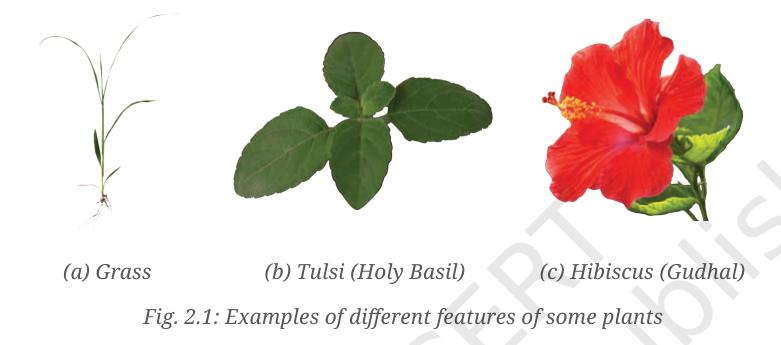
 Grass.jpeg)
 Tulsi (Holy Basil).jpeg)
 Hibiscus (Gudhal).jpeg)
Table 2.1: Observations of different plants around us
| Plant Name | Stem (Hard/Soft) | Leaves (Shape, Color) | Flowers (Color, Shape) | Any Other Feature |
|---|---|---|---|---|
| Grass | Soft, green | Long, narrow, parallel | Small | |
| Tulsi | Soft green stem | Oval, green | Small purple flowers | Aromatic |
| Hibiscus | Hard, green stem | Oval, shiny | Large, red/pink flowers | Large petals |
What similarities and differences did you find among the plants that you observed?
You must have observed that plants have a variety of features such as—
• tall/short, hard/soft stem
• different shapes of leaves and their arrangement on the stem or branches
• flowers varying in colour, shape, and scent
Now, create a list of animals you observed during this walk or from your previous experiences. Record the places where they live, the food they eat and the ways they move around in Table 2.2. Some examples have been provided for you.
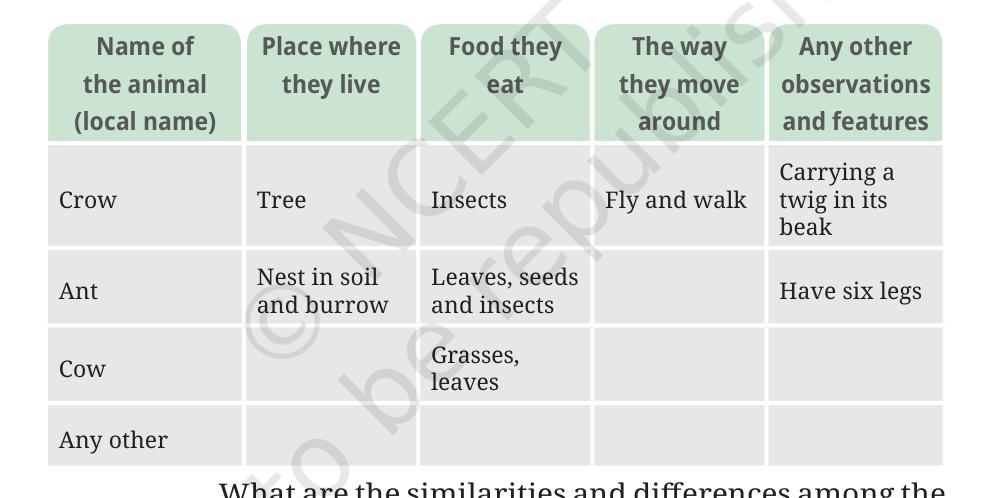
Table 2.2: Observations of different animals around us
| Animal Name | Habitat (Where it lives) | Food it eats | Way it moves |
|---|---|---|---|
| Bird | Trees, roofs | Seeds, insects, fruits | Flies with wings |
| Butterfly | Gardens, parks | Flower nectar | Flies |
| Ant | Ground, under soil | Crumbs, fragments | Walks on legs |
What are the similarities and differences among the animals that you have observed and recorded in Table 2.2?
You would have observed that some animals live on land while some others live on trees. Birds live on trees. Fish live in water and some animals like frogs live on land as well as in water. Animals also have a variety of foods they consume and movements they exhibit.
Sketch the plants and animals observed by you in your notebook or prepare a scrapbook with leaves, flowers from different plants and feathers from animals. Write all the details you have gathered about them.
While travelling to and from school, observe your surroundings and look out for a variety of plants and animals. Add the name of any plant or animal that you have not listed before in Tables 2.1 and 2.2.
- •Close your eyes for 30 seconds and think of one plant and one animal that you have closely observed and have appreciated very much.
- •Now each one of you can draw the plant and animal that you thought of on the blackboard.
- •What are your observations about the various plants and animals that have been drawn?
• How many different plants and animals did the entire class draw on the blackboard?
• Do you think that there may be many more varieties of plants and animals other than those drawn on the board?
Each member in the biodiversity of a region has a different role to play. For example, trees provide food and shelter to some birds and other animals, animals help in spreading seeds after eating fruits, and so on. Can you think of more such examples? This shows that plants and animals are dependent on each other.
How would you arrange your books and notebooks in groups? Would arranging them in groups help you better organise your school bag?
Now, let us look at the world around us. We are surrounded by a variety of plants and animals with different features about which you have learnt in section 2.1. We can group them based on similarities and differences among them.
- •Collect pictures of various other plants and animals. Cut their pictures from old magazines, newspapers, charts and other sources. Paste each of these pictures on a different card.
- •Divide your class in groups of 5–6 students each.
- •Pool the cards prepared by the students in your group.
- •Observe various features of plants and animals shown on the cards.
- •Recall the features of plants and animals that you have listed in Tables 2.1 and 2.2.
- •<strong>Group</strong> them on the basis of common features.
- •Share and discuss the basis of grouping you have made with other groups in your class.
You will be surprised to see that the basis used by different groups may vary. What do you think are the reasons behind it? Different students might have chosen different common features for the grouping. For example, some students may have chosen the height of plants as the basis for grouping while others might have chosen presence or absence of flowers as the basis for grouping of plants.
You may have grouped animals based on varied features, such as what they eat, where they live, what colour they are and how they move.
You must have noticed that plants show variation in the features related to stems, leaves, flowers, and more. The stems of different plants vary in thickness, height, and hardness, while the leaves vary in shape, colour, size and arrangement. You might have tried grouping the plants in Activity 2.3 using one of these features.
You might have also learnt in earlier classes that plants can be grouped into herbs, shrubs, and trees based on their height and types of stem. Let us study the features of plants in more detail and group them on that basis.
- •Let us go on a nature walk again for some more interesting observations.
- •Look closely at the heights of different plants. Are these plants shorter than you, as tall as you, or taller than you?
- •Is the stem brown or green? Touch and feel their stems and try to bend them gently. Can you bend the stem easily, or is it stiff? Take care that stems do not break.
- •Also, observe from where the branches of the plants arise—whether they arise close to the ground or higher up on the stem. Fill in your observations in Table 2.3. A few examples are already given.
Table 2.3: Grouping of plants based on height and nature of stem
| Plant Name | Height (Compared to you) | Stem (Color, Hardness) | Branches from Ground (Yes/No) |
|---|---|---|---|
| Tomato plant | Shorter | Green, soft | Yes |
| Rose bush | Shorter | Brown, hard | Yes |
| Mango tree | Taller | Brown, very hard | No |
| Grass | Much shorter | Green, soft | Yes |
What differences do you observe among herbs, shrubs, and trees? How can you group plants as herbs, shrubs, and trees based on the data entered in Table 2.3?
 Tree.jpeg)
 Shrub.jpeg)
 Herb.jpeg)
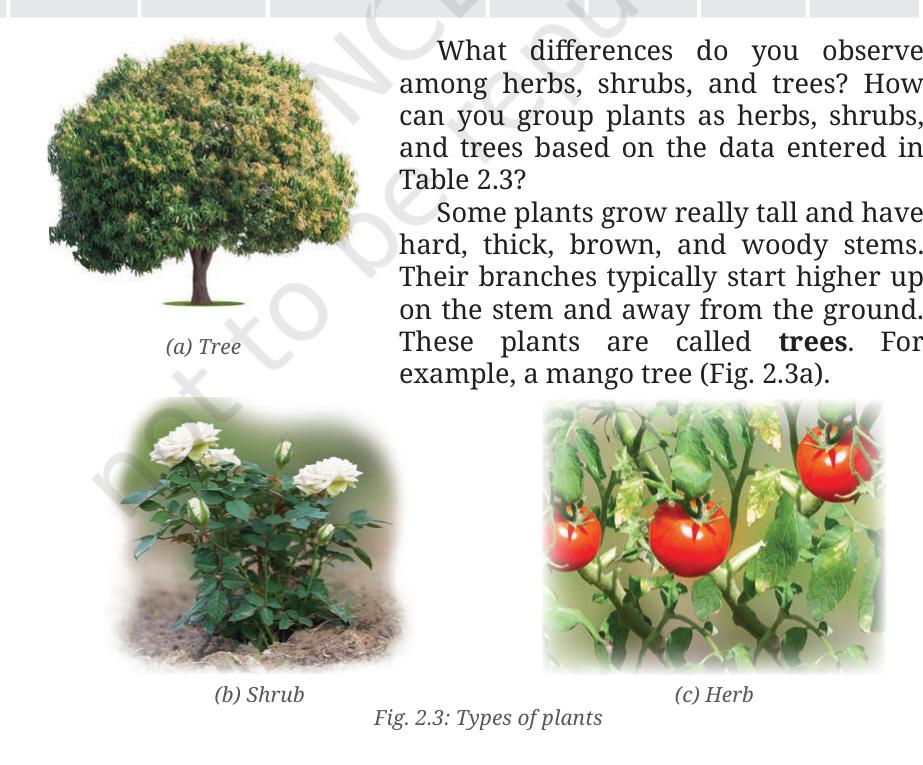
 Shrub A rose bush with white flowers and green leaves, growing close to the ground.jpeg)
 Herb A tomato plant with green stems and ripe red tomatoes.jpeg)
What can be other features on the basis of which you can group plants? Let us perform another activity.
- •Look at the leaves of different plants collected by you, during the nature walk.
- •Do you notice the variation in the shape and structure of these leaves?
You may observe thin lines on the leaves of the plants. These are veins. The pattern of veins on the leaf is called venation. What differences do you see in the veins of leaves?
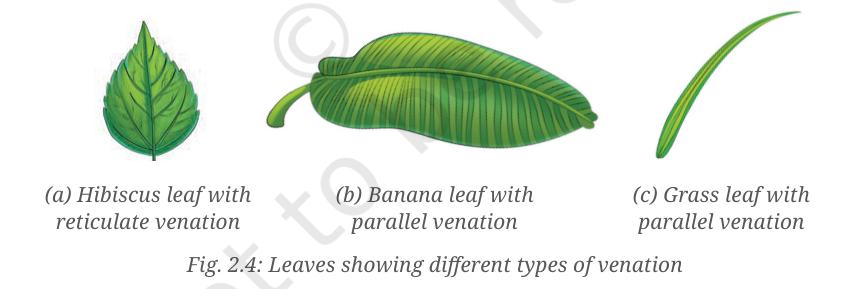
 Reticulate venation.jpeg)
 Parallel venation.jpeg)
Do you think that plants can be grouped on the basis of venation present in their leaves?
Now, let us try to explore roots of the plants. Do all plants have roots? Are these roots similar?
- •Visit an open area where wild herbs and grasses are growing. You may use small herbs for this exercise.
- •Using a <em>khurpi</em> (trowel), carefully dig out a few different herbs without damaging the roots. To do this, you may wet the soil and loosen it.
- •Wash the roots with water and observe them.
- •After you are done observing, make sure to replant the herbs so that they may continue to thrive and grow.
What are the similarities and differences in the roots of the plants collected by you? What differences do you see in the roots of plants?
 Taproot system.jpeg)
 Fibrous root system.jpeg)
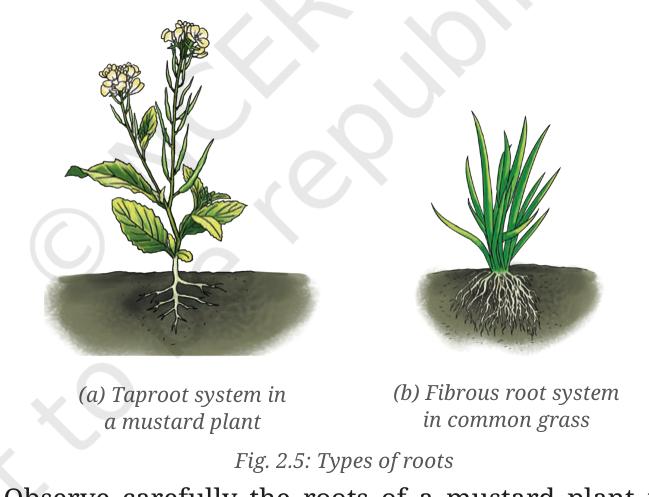
Is there any relation between the type of leaf venation and the type of root of the same plant? How do we find this out?
- •Collect saplings of five common plants from your school nursery or any other nurseries to plant in your school garden. Examples of such plants can include lemongrass, marigold, sadabahar (periwinkle), and others.
- •Before planting them, observe their roots and the venation in their leaves.
- •Record your observations in Table 2.4.
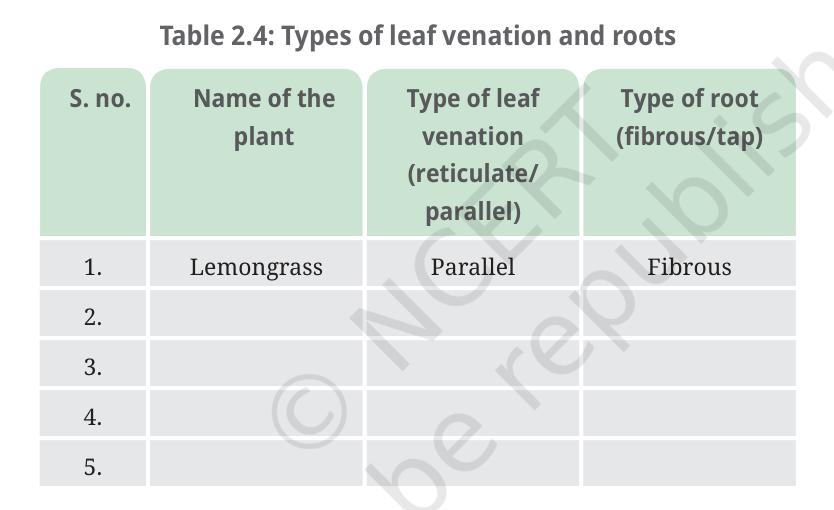
Table 2.4: Types of leaf venation and roots
| Plant Name | Leaf Venation (Type) | Type of Root System |
|---|---|---|
| Sadabahar | Reticulate | Taproot |
| Lemongrass | Parallel | Fibrous |
Do you observe any relation between the leaf venation and types of root in these plants? A sadabahar plant has a taproot and its leaves have reticulate venation. Do other plants with reticulate venation have taproots too? Lemongrass, on the other hand, has fibrous roots and its leaves have parallel venation. Do other plants with parallel venation have fibrous roots too? Generally, plants with reticulate venation have taproots while those with parallel venation have fibrous roots.
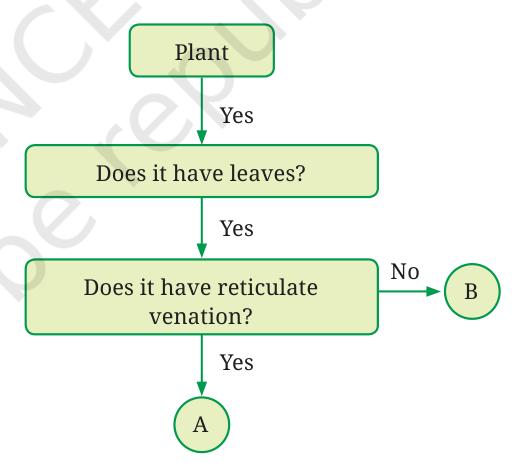
Chickpea (chana) is another example of a plant with taproots and reticulate venation in leaves. Wheat is an example of a plant with fibrous roots and parallel venation in its leaves.
 Kidney beans.jpeg)
 Wheat.jpeg)
Is there any relation among the seed of a plant, types of root and leaf venation? Are all seeds similar?
- •Soak some chickpea and maize seeds in water for two or three days.
- •Remove the seed coat of a chickpea. Now, observe the structure of the chickpea and maize seeds. Are they similar or different?
 Dicot seed (chickpea).jpeg)
 Monocot seed (maize).jpeg)
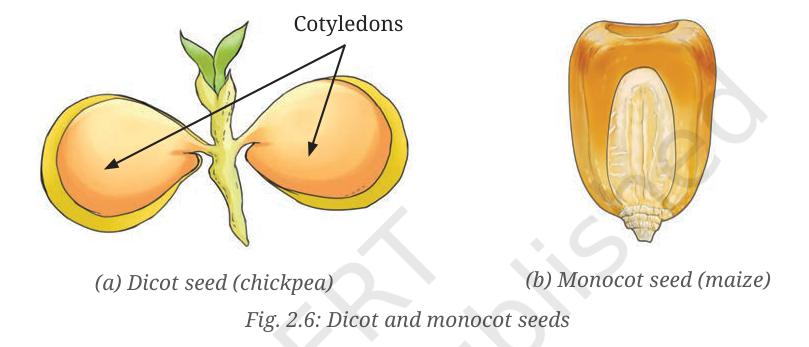
What relation do you observe among leaf venation, root types and the number of cotyledons in seeds of a plant? Dicot plants have reticulate venation and a taproot system while monocot plants have parallel venation and a fibrous root system.
You have learnt about some features used for grouping plants. Now, let us explore the grouping of animals in more detail.
Just like plants, animals too are significantly different from one another. How can we group such a wide variety of animals? What features can you think of to group them? In Activity 2.3, you have already set some bases for grouping animals. Let us explore a few of these in more detail.
- •You have recorded the movement of a few animals in Table 2.2. You may have also observed how other animals move from place to place. Let us now think about the types of movement in animals.
- •List these animals in Table 2.5.
- •Note the ways in which these animals move and name the body parts used for movement. Some examples are given in Table 2.5.
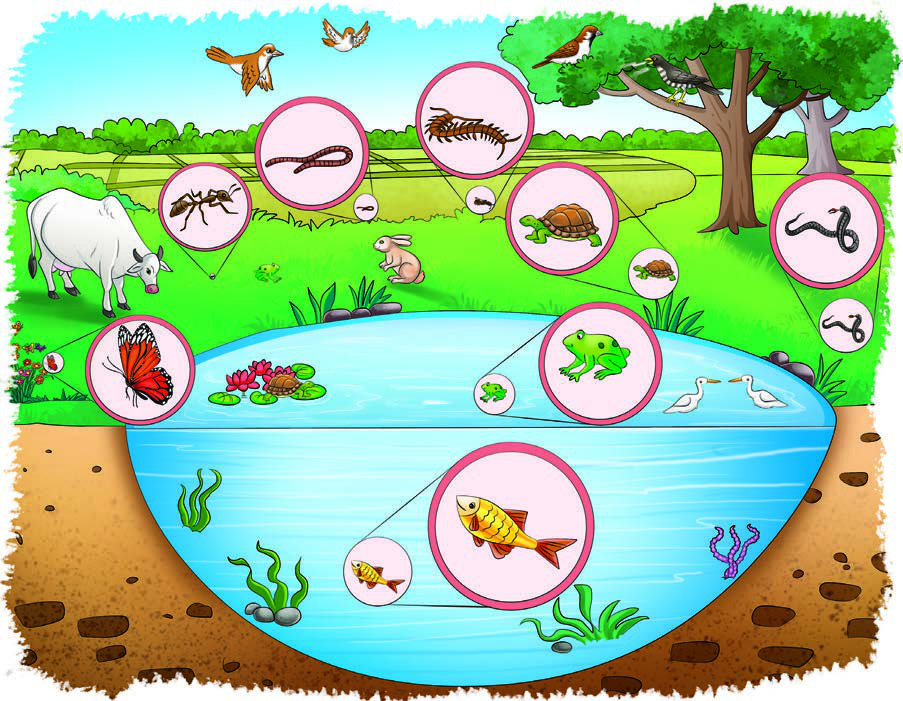
Table 2.5: Movements in animals and their body parts involved
| Animal Name | Type of Movement | Body Parts Used for Movement |
|---|---|---|
| Bird | Flying | Wings |
| Fish | Swimming | Fins |
| Ant | Walking | Legs |
| Earthworm | Crawling | Body segments |
| Frog | Jumping/Swimming | Hind legs/Flippers |
| Butterfly | Flying | Wings |
| Snake | Slithering | Body muscles |
What conclusions can you draw from the data given in Table 2.5?
Different animals have different types of movement. Animals can fly, run, crawl, walk, hop or jump, and so on. These animals use different body parts for moving from one place to another. They may use wings, legs, and other parts that help them to move. Here, we have identified animals based on the types of movement and the body parts used for movement. How can we group animals based on their movements? Additionally, many animals differ from each other in shape, size, structure, colour, and other features. Some of these features can also be used to group animals in various ways. Like plants, grouping of animals is important for understanding their diversity.
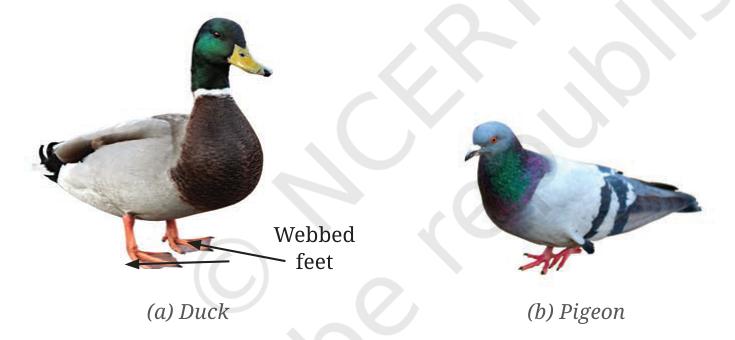
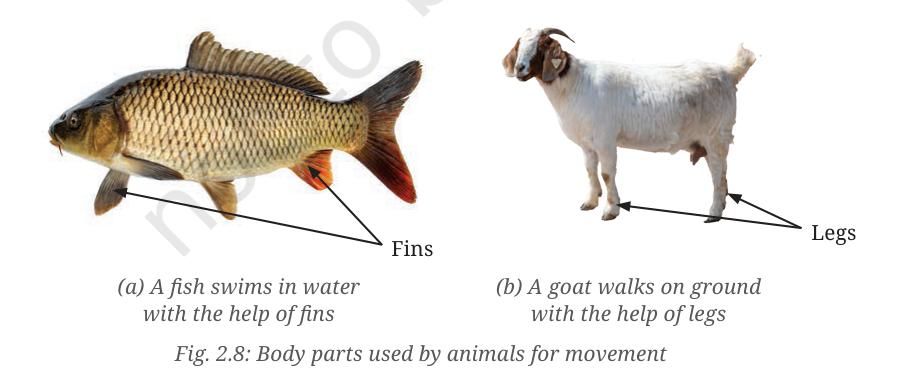
You might have observed during nature walks that different animals live in different surroundings. You have also recorded movement of animals in Table 2.5. Does the movement of these animals depend upon their surroundings? Let us consider fish and goats as examples. Fish live in water. They have streamlined bodies and fins for movement in water. Goats live in grassy areas and move with the help of legs. The sizes and shapes of animals also differ from one another.
 Goat found in the plains.jpeg)
 Mountain Goat.jpeg)
 A fish swims in water with fins.jpeg)
 A goat walks on ground with legs.jpeg)
- •Look at Table 2.6. Recreate a similar table on the blackboard.
- •List the names of plants and animals you or your classmates have observed in these regions or already know about. A few examples are given. You can add more.
Table 2.6: Animals and plants found in different surroundings
| Region Type | Plants Found | Animals Found |
|---|---|---|
| Desert | Cactus, acacia | Camel, lizard, scorpion |
| Mountain | Deodar, pine, rhododendron | Snow leopard, yak, eagle |
| Forest | Oak, rosewood, sal | Tiger, deer, elephant |
| Grassland | Grasses, shrubs | Zebra, lion, antelope |
| Aquatic (Water) | Water lily, seaweed | Fish, frog, duck |
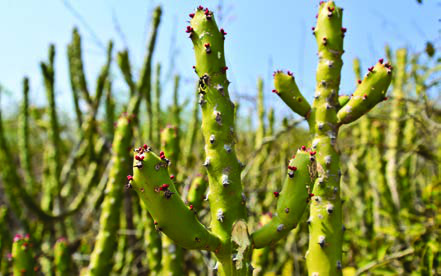
What are your observations regarding plants and animals found in various regions? Discuss your observations with your classmates.
You might observe from Table 2.6 that the plants and animals found in one kind of region are different from those found in another kind of region.
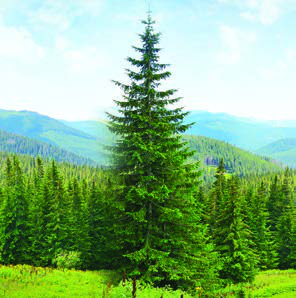
During a discussion in the classroom, Alex recalls that he observed cactus plants with thick and fleshy stems in the deserts of Rajasthan. Maya shares that she saw deodar trees in the Himalayas of Himachal Pradesh. These trees are conical in shape and have flexible and sloping branches.
Notice that these two types of plants found in different regions are different from each other. Why is it so? Why does the biodiversity of a region vary from that of another? Let us find out.
There is very little water available in the deserts. A hot desert is typically very hot during the day and very cold at night. Therefore, you will find plants and animals in these areas that can tolerate and survive both the hot conditions during the day and cold conditions at night. The fleshy stems of plants found in the desert can store water and help them tolerate the hot conditions in these places.
The mountains in extremely cold regions experience frequent snowfall. In order to survive in such conditions, some of the trees have the ability to let the snow slide off easily. Conical shape and sloping branches of deodar trees enable them to do so easily.
You must have understood by now that the biodiversity varies from region to region because of diverse conditions.
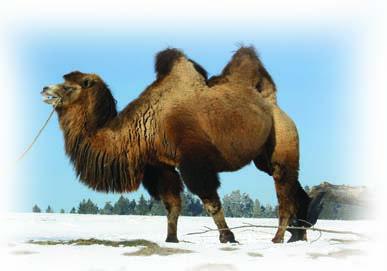
Look at the images of a camel from the hot desert of Rajasthan and a camel from the cold desert of Ladakh. What are the differences you observe between them? What advantages do these differences provide to these camels?
 Camel in cold desert of Ladakh.jpeg)
 Camel in hot desert.jpeg)
The camel in the hot desert has long legs with wide hooves. Alex shares that his grandmother told him that the long legs and wide hooves help these camels to walk on the sandy desert without sinking into the sand. On the other hand, the height and legs of camels in a cold desert are comparatively shorter than those found in a hot desert. These short legs allow them to walk easily in mountainous regions.
In deserts, food is not available easily. Camels store food in their humps. Camels in the hot desert have one hump each that helps them to survive during the scarcity of food. Camels in the cold desert have two humps each. These two humps shrink in late winters because there is not much food available in the cold desert and they have to use food stored in their humps during that time. Moreover, they grow long hair from head to neck, which help them survive the cold winters of Ladakh.
What other features can help camels to survive in the desert?
Other students also start sharing their observations. Kashi from Rajasthan says that camels excrete small amounts of urine, their dung is dry, and they do not sweat. As camels do not lose much water from their bodies, they can survive for many days without drinking water.
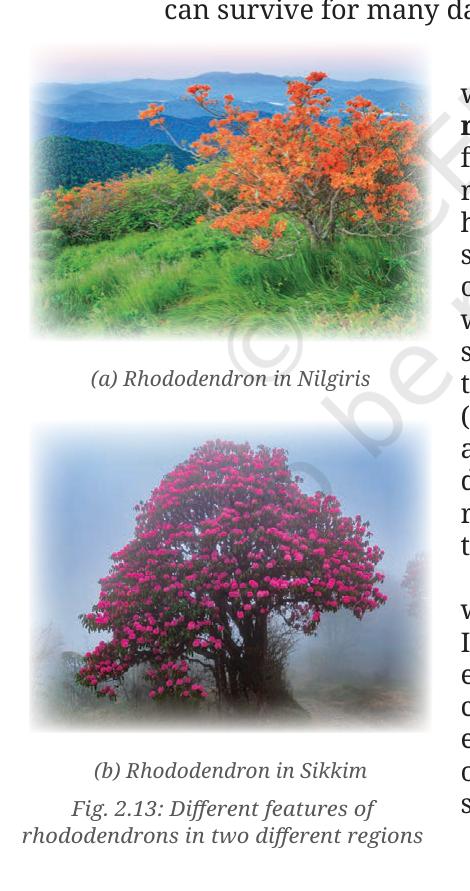
Maya talks about seeing plants with beautiful bright flowers, rhododendrons, in the Shola forests of Nilgiris. Here, rhododendrons are of shorter height and have smaller leaves to survive through the heavy winds on mountain tops. However, Pema, who is from Sikkim, mentions that she has observed rhododendrons in the nearby mountains to be taller. So, even plants such as rhododendrons may exhibit different features in different regions to survive the conditions of those regions.
Sagar tells his classmates that he went to the Andaman and Nicobar Islands with his parents for a special event. He saw huge whales and colourful fish in the ocean. His father explained that the streamlined body of fish makes it easier for them to swim in water.
 Rhododendron in Nilgiris.jpeg)
 Rhododendron in Sikkim.jpeg)
What would happen if the habitat of a plant or an animal is damaged? What would happen if a goat does not get grass to eat? Can a fish survive without water?
Check with your parents, grandparents and neighbours to know about the plants, birds, insects or any other animal they used to see frequently in their childhood but do not see as often now. These changes often happen when habitats are damaged. The damage to habitats of plants and animals results in loss of their homes, food, and other resources. This leads to the loss of biodiversity.

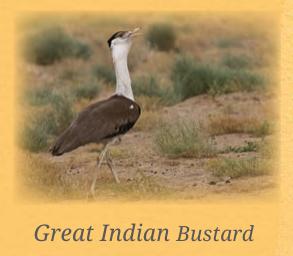
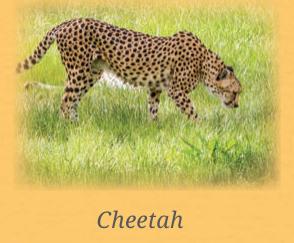

We must protect biodiversity to ensure our planet is full of life, helping plants and animals to survive and thrive.
Keywords
- 1We are surrounded by a large variety of plants and animals. Such variety of plants and animals is a part of biodiversity.
- 2Plants and animals can be grouped on the basis of similarities and differences among them.
- 3Plants have similarities and differences based on features associated with roots, stems, leaves, flowers, and so on.
- 4The method of arranging things into groups based on their common features is called grouping.
- 5Plants can be grouped into herbs, shrubs, and trees based on their heights, types of stem, and branching patterns.
- 6Plants can also be grouped as dicotyledons (dicots) and monocotyledons (monocots) based on the number of cotyledons in their seeds.
- 7Monocots generally exhibit parallel venation in their leaves and possess fibrous roots while dicots typically exhibit reticulate venation in their leaves and possess taproots.
- 8Animals have different types of movement that can be a basis for their grouping.
- 9Biodiversity of different regions varies because of distinct environmental conditions.
- 10The special features that enable plants and animals to survive in a particular region are called adaptations.
- 11The place where plants and animals live is their habitat.
- 12Based on their habitats, animals and plants can be grouped into terrestrial and aquatic.
- 13Due to damage of their habitats, plants and animals lose their homes, food and other resources resulting in the loss of biodiversity.